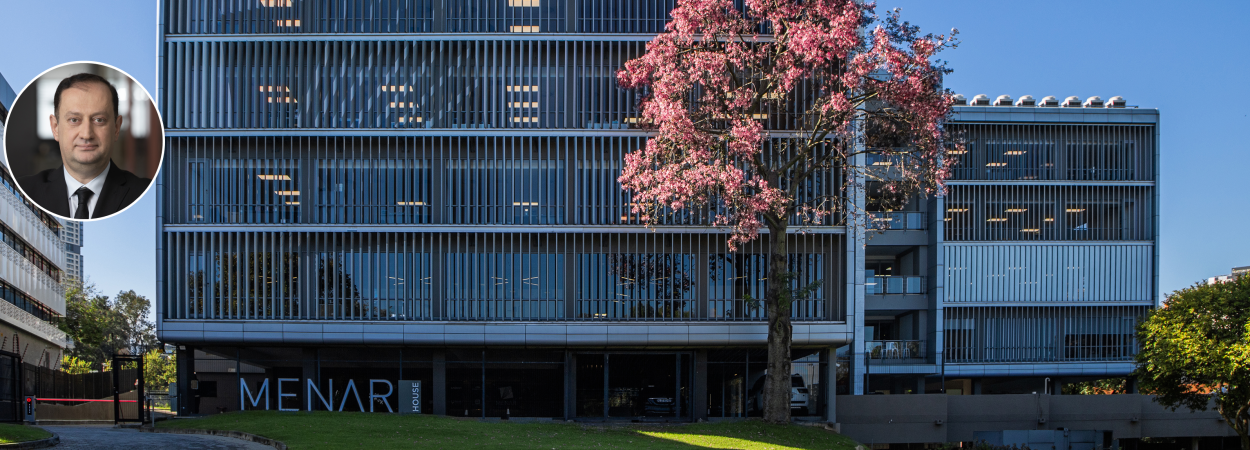
Menar MD finds much to criticise in Eskom’s green plans and in the presidential
climate commission
Eskom ’s announcement that it will convert five of its coal-fired power stations into renewable energy sites poses a threat to the little that is left of South Africa’s dwindling industrial capacity. It is part of a high-risk energy policy trajectory that elevates decarbonisation above industrialisation.
The 2024 integrated resource plan published by Gwede Mantashe, then minister of mineral resources & energy, highlights the importance of striking a balance between competing interests when considering South Africa ’s energy future.
The document concludes that energy policy must be based on three interrelated imperatives: long-term decarbonisation trajectory, economic competitiveness and industrial renaissance. All three aspirations — carbon emission reduction, energy affordability and security of energy supply — are important.
A balanced approach would be reasonable as it could make beneficiation, one of the goals of the country’s critical minerals strategy of 2025, to become a reality. A single-minded pursuit of reducing emissions could frustrate an industrialisation renaissance.
South Africa is already suffering from deindustrialisation due to high energy costs. Examples are the closure of energy-intensive manufacturing industries such as manganese and chrome smelters and the declining competitiveness of what is left of crisis-prone steelmaker ArcelorMittal South Africa.
While Eskom’s leadership has made good progress in improving the reliability of coal-fired power plants, thus reducing load-shedding, there appears to be no electricity price relief in sight as the company uses tariff increases to make up for the overall decline in energy output and sales.
Tariffs will continue to rise. And things will get worse as South Africa’s energy policy, which favours decarbonisation, is leading to the substitution of Eskom ’s coal-fired baseload capacity with variable energy on five sites. There have been suggestions that one site, Kriel, could include gas, but the feasibility is unknown.
In recent presentations to the presidential climate commission and in parliament, Eskom said it had begun work to repower the Grootvlei, Arnot, Camden, Hendrina and Kriel power stations into renewable energy and battery storage facilities in 2030.
This effectively means substituting baseload capacity with weather-dependent capacity. The decision came after the approval of $2.6bn (R46bn) in financing of this project from the Climate Investment Fund (CIF) in June.
In its 2024 annual report published in December, Eskom stated it had kept the power stations running because of the energy crisis and the delay in the new independent power producer (IPP) capacity being connected to the grid. It seems this was based on a wrong assumption that renewable IPPs could fill the gap and prevent the energy crisis.
Eskom also stated at the time that it had a plan to repower the plants to mitigate the socioeconomic impact on affected communities of “the eventual ramp down of the coal industry.”
It was not clear at that time what form the “repowering ” could take. It seems the assumption was that repurposing the plants into renewable energy sites could mitigate socioeconomic problems. Yet the victims won ’t only be the surrounding communities; the competitiveness of the whole economy stands to suffer.
When electricity minister Kgosientsho Ramokgopa visited China recently, one of his priorities was to investigate the possibility of sourcing clean coal technologies to retrofit Eskom power stations. While this option and other carbon mitigation solutions are still under consideration for the remainder of Eskom’s coal fleet, they are unjustifiably overlooked for the five plants whose capacity now stands be decimated.
This trajectory of a decarbonisation strategy is bad for a struggling economy because it relies on decapitating baseload instead of modernising it while adding renewables. There is a big driver behind the decision: money. The availability of funding from the accelerated coal transition programme of the CIF played a role in the government’s policy.
Eskom ’s poor financial health and the government’s weak fiscal position have meant South Africa’s energy policy-making sovereignty is compromised. Funding conditions linked to the closure of coal-fired plants are being accepted regardless of the consequences.
Eskom ’s plans for the five coal-fired power stations won ’t help us achieve an industrial renaissance. We face the real risk of becoming an industrial desert.
At a recent European ferroalloys conference I attended, many industry players expressed concern about energy security and the competitiveness of their products. China is the least concerned because it’s engaged in energy addition, expanding renewable capacity while doubling down on baseload capacity. The US is now pursuing a policy of energy dominance, clearly to compete with China’s low manufacturing input costs.
When Tata Steel announced in 2024 it was shutting down blast furnaces at its UK Port Talbot operation, retrenching 2,800 people, The Guardian described the developments as a “gut punch” to British industry. High energy prices and the imperatives of decarbonisation drove the company to turn to electric arc furnaces that would produce steel from recycled material.
South African industry is the victim of multiple gut punches. And more are to come. This is to be expected since our energy policies are cut-and-paste from the highly developed nations of Europe. As we ramp down coal and ramp up renewables, we will soon experience our own version of Germany’s dunkelflaute — wind and solar drought — along with regular threats to grid stability.
Eskom ’s latest decision makes one think that perhaps we need a presidential reindustrialisation commission staffed by competent and patriotic industrialists to balance the work of the presidential climate commission.
Bayoglu is MD of Menar, a private investment company with interests in coal mining and ferromanganese
This opinion piece was published in the Sunday Times: https://www.businesslive.co.za/bt/opinion/2025-08-10-vuslat-bayoglu-stick-with-fossil-fuel-for-baseload/
Categories: Opinion Pieces
 Vuslat Bayoglu