15 000 MW capacity is under threat
Whether we like it or not, South Africa’s economy is tied to Eskom. As we have seen recently, Eskom’s failures, as a result of poor decision-making in previous years, caused economic damage. Conversely, fixing Eskom means fixing the South African economy. And fixing Eskom largely means making sure all its power plants operate at decent capacity.
But while there have been noticeable improvements in the last 14 months as long spells of loadshedding have gradually been addressed, there is a new threat facing the power utility – and the economy.
On March 31, the Minister of Environment Forestry and Fisheries, Dion George, will decide the future of Eskom – and the South African economy. He will either reverse Eskom’s gains in reducing loadshedding or help it to continue its recovery path.
The power of the minister to decide on Eskom’s future capacity arises from his power over environmental licence conditions to Eskom, particularly minimum emissions standards.
Eskom has applied for exemptions to the minimum emissions standards in key power stations to allow it to continue operating them beyond 2030, while it actively addresses emission concerns. The minister must take a pragmatic decision in the interest of Eskom and the South African economy which can’t afford to lose a single Megawatt of available capacity.
Previously, former Environment Minister, Barbara Creecy, had given Eskom exemptions that helped the power utility and the country avert a total blackout. Without the exemptions at least a whopping 30 000 MW capacity would have been at risk of being lost.
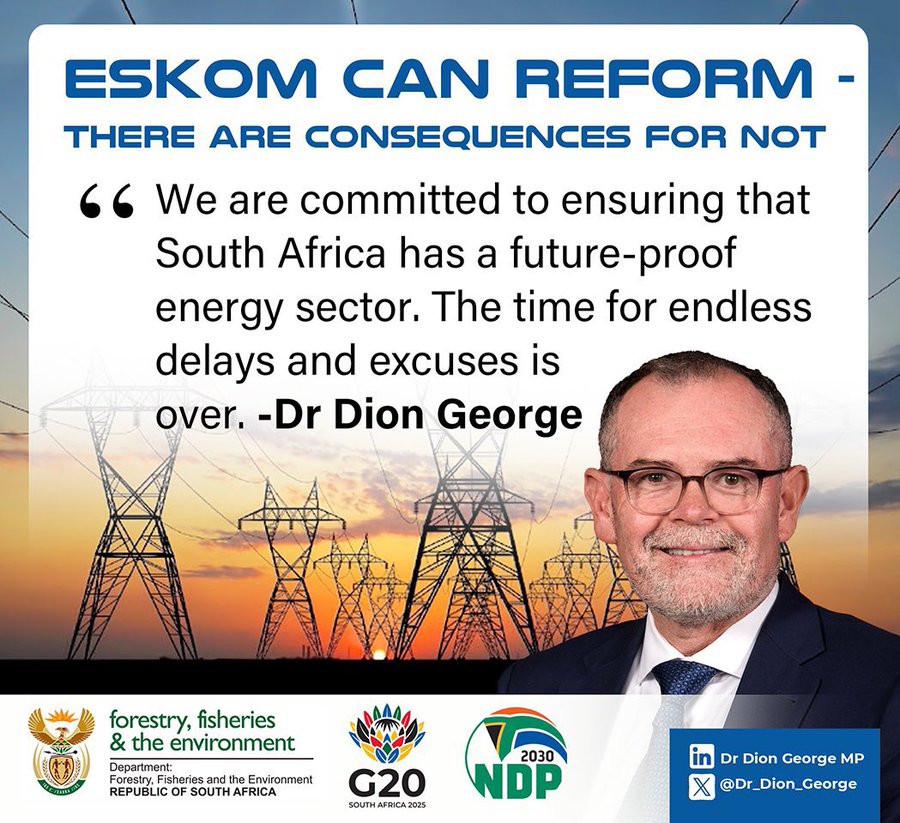
Eskom does not ask for blanket exemptions in its current application to Minister George, but requests approval for its emissions reduction plans in eight of its power stations to operate them beyond 2030. The utility seeks to manage and reduce particulate matter, nitrous oxide, and sulphur dioxide through improved efficiencies at various generation units.
In a recent interview with Creamer Media, Minister George seemed to imply that he has wide discretion to decide on the exemptions. Legally, yes. Practically, not entirely. The economy cannot afford a situation where Eskom shuts down 15 000 MW either because the conditions imposed on it are untenable or an ideological decision is taken to end coal baseload in favour of intermittent renewables.
The government has advanced in its plans to unbundle Eskom to enable privately generated power to feed into the grid. But what’s missing from the plan is a provision for private investors to invest in retrofitting Eskom’s old plants to meet emissions requirements in the long term.
The current temporary measures of exemption applications have introduced unpredictability into Eskom’s plans, thus injecting risk to the entire economy. We cannot afford to live on the edge of a cliff, waiting for a minister to decide to switch off half or all of Eskom.
Minister George has no choice in the matter. He must guide Eskom towards manageable compliance without strangling the fragile economy. I trust that the minister will take the right decision on behalf of the Government of National Unity in the interest of South Africa’s energy security.
Categories: Opinion Pieces
 Vuslat Bayoglu
You must be logged in to post a comment.