Public institutions that suffer from inertia need a good dose of public criticism to remind them of their duty to the public
We do a lot of this kind of reminding in South Africa — even to the point of unfairly overlooking institutions that perform well.
Indeed, those that do well and inspire public confidence deserve recognition to spur them on. One such institution is South Africa’s Council for Geoscience (CGS), which conducts geological surveys and cutting-edge scientific research. Under the leadership of CEO Mosa Mabuza, the CGS has been doing some wonderful work that has the potential to enhance the country’s long-term energy security.
The institution’s recent research output has focused on energy security, seeking to ensure long-term use of nuclear and coal — reliable baseload fuels that are not weather dependent. Given the dark days of load-shedding we’ve been through, any work that seeks to enhance energy security is necessarily in the national interest.
The national interest was well advanced in July when the CGS announced it had concluded a probabilistic seismic hazard assessment on behalf of Eskom in the Western Cape, where the power utility ’s Koeberg nuclear power facility is situated. The results of the survey supported Eskom’s submissions to the National Nuclear Regulator for the expansion of the life of the power station.
The CGS enabled Eskom to extend Koeberg’s operating licence to 2044. This guarantees South Africa a baseload equivalent of 1,860MW or about 4.2% of the country’s electricity, according to Eskom. Certainly not a small contribution, if one considers reliability. After the conclusion of the seismic survey, the CGS said the research highlighted “the pivotal role of science in critical decision-making processes for future planning”. It said the research affirmed that “geoscience plays a vital role in energy security, mineral development, infrastructure and land-use planning.”
This is a huge milestone. Taken to its logical development stage, the research output would be crucial for South Africa’s energy transition. At the ceremony to announce the findings, Mabuza told government policymakers, including mineral & petroleum resources minister Gwede Mantashe and Mpumalanga premier Mandla Ndlovu, that the success of carbon storage and utilisation would produce “green coal”.
The coal economy — coal mining and associated downstream industries — is at the heart of the economy in Mpumalanga and South Africa at large. About 130 collieries operate in the province, which is also home to the bulk of Eskom’s power fleet and hosts Sasol’s plant in Secunda. Mpumalanga is also the nerve centre of South Africa’s electricity grid. It is therefore understandable that the science-based solution to greenhouse gas emissions was music to the ears of the government leaders and executives of major coal-mining companies in attendance.
The scientific finding means that South Africa stands a good chance of using what Mabuza called “green coal” — a fuel with significantly reduced carbon emissions during beneficiation — over many years. This is not to say this should be at the expense of other energy sources such as renewables. Only those who play in the field of emotions prefer the exclusion of other technologies. We are better with a mix of energy sources, all contributing to the energy transition.
What is important for the country’s economy is to have a reliable and cheap electricity supply that can power our reindustrialisation, generate economic growth, create jobs and neutralise the powder keg of potential social unrest. The CGS findings come a few months after another initiative to test carbon-capture technologies was announced at the coal fired Kelvin power station in Johannesburg.
These initiatives are in their early stages. But like all scientific discoveries, they are exciting as they have the potential to deliver wonders to our ever-increasing demand for energy. Taken to their logical conclusion, the research output on carbon capture, utilisation and storage could debunk the conventional interpretation of the energy transition myth — that transition from high-carbon economy to low- carbon footprint is synonymous with abandoning coal.
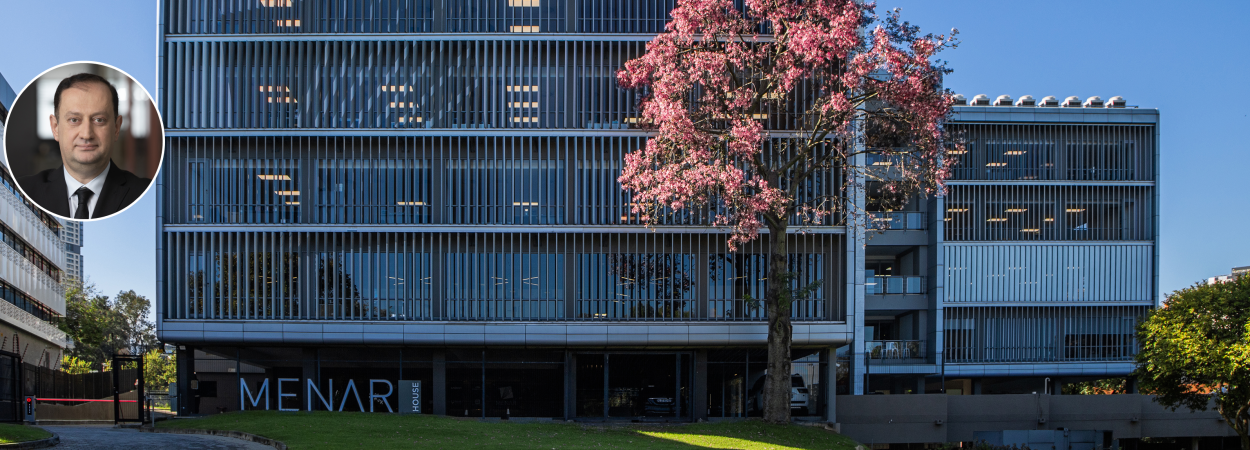
Bayoglu is MD of Menar, a South African mining company with an actively managed and growing portfolio of diversified minerals.
This opinion piece was published in the Business Day: https://www.businesslive.co.za/bt/opinion/2024-10-20-vuslat-bayoglu-south-africa-stands-good-chance-to-use-green-coal-for-years/
Categories: Opinion Pieces
 Vuslat Bayoglu